Frequently Asked Questions
What and where is Iceland?
Iceland, population 317,000, is a modern Western liberal democracy located in the north Atlantic. It is about the size of Ireland and lies midway between North America and Europe. In 2007, Iceland was ranked as the most developed country in the world by the United Nations Human Development Index. It generates over 99% of its electricity and hot water from geothermal power and has been ranked as the "greenest" country in the world. In late 2008, following the financial crisis in the United States, the country nationalized its three largest banks which were at risk of insolvency. Related events saw unprecedented protests in the capital of Reykjavik and a new government was elected in April 2009. The country is best known for its pristine wilderness, its singer Bjork, the Reagan-Gorbachev summit and the Fischer-Spassky world-championship. Icelandic democracy is one of the oldest in the world. Its still acting parliament, the Althingi, was founded in 930 AD.
Iceland is a great place to run large internet sites. It has cheap 100% green power, natural cooling, plenty of bandwidth and is close to both Europe and the east cost of the United States. It is within the Eupean Economic Area and the Schengen zone, has a educated young workforce and a 15% company tax.
Who in the parliament is supporting the proposal?
19 out of the 63 MPs in the Icelandic Parliament are making the proposal. They come from all parties represented in the parliament: The Social Democratic Party (SDP), Left Green Party (LG), the Independence Party (IP), the Progressive Party (Pr) and the Movement (M).
The MPs are: Birgitta Jónsdóttir (M), Atli Gíslason (LG), Árni Þór Sigurðsson (LG), Ásmundur Einar Daðason (LG), Erla Ósk Ásgeirsdóttir (IP), Eygló Harðardóttir (Pr), Guðfríður Lilja Grétarsdóttir (LG), Gunnar Bragi Sveinsson (Pr), Lilja Móesesdóttir (LG), Lilja Rafney Magnúsdóttir (LG), Margrét Tryggvadóttir (M), Róbert Marshall (SDP), Sigmundur Ernir Rúnarsson (SDP), Sigurður Ingi Jóhannsson (Pr), Vigdís Hauksdóttir (Pr), Tryggvi Þór Herbertsson (IP), Þór Saari (M), Þórunn Sveinbjarnardóttir (SDP) and Ögmundur Jónasson (LG).
What is included in the proposal?
- The Icelandic Prize for Freedom of Expression
- Iceland's first internationally visible prize.
- An ultra-modern Freedom of Information Act
- Based on the 2009 CoE and OAS recommendations as well as modern elements in the FOI laws of Estonia, Scotland, the UK and Norway as well as the Aarhus treaty. (scope: Iceland)
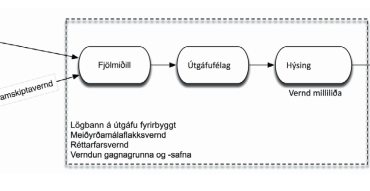
- Whistleblower protections
- Protection for those who step forward to reveal important matters in the public interest, based on the U.S. False Claims Act and the U.S. Military Whistleblowers Act. (scope: Iceland)
- Source protection
- Protection for anonymous sources who attempt to communicate to the public after a promise of confidentiality by a journalist or media organization. Based on new EEA legislation.
- Source-journalist communications protection
- Protection for the communications between an anonymous source and a media organization and internally within a media organization prior to publication. Based on the Belgium source protection law of 2005.
- Limiting prior restraint
- Prior restraint is coercion of a publisher, by a government authority, or through the judicial system, to prevent publication of a specific matter. While the Icelandic Constitution provides the right to freedom of expression, small modifications are needed to reduce the possibility of prior restraint.
- Protection of intermediaries (internet service providers)
- Immunity for "mere conduits", ISPs and telecommunications carriers.
- Protection from "libel tourism" and other extrajudicial abuses
- Non-observance of foreign judgments that violate Icelandic freedom of expression protection, and the ability to file a counter-suit in Iceland against a party who engages in a calculated attempt to suppress the speech freedoms of an Icelandic entity. Inspired by legislation passed by the states of New York and Florida and proposed legislation elsewhere.
- Statute of limitations on publishing liabilities
- Recent rulings in Europe maintain that, for a internet publications, each page view is publication afresh, regardless of how long ago the material was first released. This has resulted in the silent removal of investigative newspaper stories, including those over five years old, from the on-line archives of the Guardian and and other major newspapers.
- Process protections
- The majority of legal suits related to publishing settle before final judgment. Hence, the court process itself must ensure that it is not used to suppress speech through unequal access to justice, subpoenas or other interlocutory motions. Process protections (called anti-SLAPP laws in the U.S.) permit a judge to declare the matter a free speech related case, at which point protections are activated to prevent such abuses.
- Virtual limited liability companies
- Based on the LLC legislation used in the U.S. state of Vermont.
How can Icelandic laws protect journalists, bloggers and sources from other countries?
At first glance it would seem that any particular nation state's laws can only affect the behavior of its own citizens and companies. However, because the world is economically and culturally connected, experience shows that the laws of one nation can affect the behavior of persons in another. Indeed, that is how, on the opposite side of the equation, "libel tourists" are able to abuse states with poor press protection laws to suppress freedom of expression in other countries.
Even halfway around the world, libel laws have the power to silence dissent. English science writer Simon Singh discovered this when he was interviewed by an Australian journalist about a book he had co-written, "Trick or Treatment? Alternative Medicine on Trial". The journalist went off to write a story about homeopathy, only to have the newspaper's lawyers kill it before publication. They were worried about being charged with defamation in London, almost 20,000 kilometres away.(1).
However these transborder effects can also be used to protect freedom of expression
For instance, the Swedish Press Freedom Act, on which part of the IMMI source protection requirements were modeled, requires that journalsts & media organizations who promise confidentiality to sources must keep their promise. If they do not, a source has the right to initiate a criminal prosecution against them in Sweden (penality six months imprisonment).
This strong protection assists not only source. It is also likey to aid journalists operating in other countries which have a meaningful publishing relationship with Sweden.
There is directly analoguous jurisprudence involving the confidentiality relationships of bankers, lawyers and accountants engaged with secrecy jurisdictions such as Switerzland and the Cayman Islands. In the Australian case of MPII vs. Sharman Networks (Kazaa) (2004-2006) an visiting foreign accountant was asked to testify as to the true owner of a Vanuatu registered company. The litigation arose out a dispute between record companies and the Kazaa file-sharing network. The record company plaintiffs wanted to know who true owners were of Sharman Networks, a Kazaa-affiliated company registered held in Vanuatu, a corporate secrecy jurisdiction. During the case, which was held in Sydney, Sharman's Vanuatu account visited Sydney. He was compelled to stand before the court and was then asked to reveal the beneficial owners of Sharman. The accountant refused, citing Vanuatu corporate secrecy law--to testify would be to commit a crime in Vanuatu for which a Sydney court could provide no remedy. It can also be argued that police and judicial officers who coerce others into breaking mandated confidences may be party to an extraterritorial crime. Whether this argument is sound in any particular jurisdiction is largely irrelevant it has been shown to work in practice. Judicial officers and bureaucrats do not want to take the risk of spending their time in litigation. Neither do they wish to risk imprisonment when travelling or asset seizure. In the Sharman case, the court accepted these arguments and did not compell the accountant to testify.
Consider also the case of the South African Competition Commission (SACC) and WikiLeaks. In December 2008, the SACC was due to release a groundbreaking 590 page report into cartel behavior (fee fixing) of South Africas four big banks. The banks, hearing of the prospective release, redactions. A heavily redacted version was released, but obtained and released an unredacted version, turning the blanked regions into highlights. The SACC demanded the unredacted report be removed. WikiLeaks refused. The South African government, scared of the power of the banks, then appointed a criminal prosecutor to discover and try WikiLeaks source. WikiLeaks lawyers then warned the SACC, that should the investigation proceed, those involved risked criminal prosecution under the laws of Sweden and Belgium.
Why? Because WikiLeaks routes the communications with its sources through Sweden and Belgium, and publishes from Sweden. The Swedish constitution has protection for source anonymity and Belgium law has protection for journalist-source communications confidentiality. Since both jursdictions were involved in a meaningful manner with the act of discloszure being investigated, both could claim jurisdiction over the matter. Whether, ultimately, the highest South African courts would recognizse the rights of Sweden and Belgium in this matter was not of consequence; it was not something that individuals within the South African government wanted to risk, nor, presumably, did they want to risk legal problems when traveling. The investigation was dropped and the source was protected.
Who stands to benefit from the proposal?
Various parties can be seen to benefit directly from the proposal, including sources, journalists, publishers, human rights organizations, Internet service providers, free speech activists and privacy advocates.
Can something similar be done in my country?
As this proposal assembles the strongest international protection laws, it can for the most part be easily applied to almost any legal system. It is of course easier to make this kind of proposal in countries with small legislative bodies, high levels of education, relatively low levels of corruption, and fast moving governments, but with enough focused effort this proposal can be applies virtually anywhere. It is our hope that this model be copied elsewhere.
What about restrictions on child pornography?
The proposal does not touch existing Icelandic/EEA restrictions.
What about restrictions on commercial copyrights?
The proposal does not touch existing Icelandic/EEA restrictions.